
The Real Cost of a Stalled Software Project (It’s Not Just the Money You Spent)
When a software project stalls most founders fixate on theinvoice. That’s the smallest part of what it costs them.
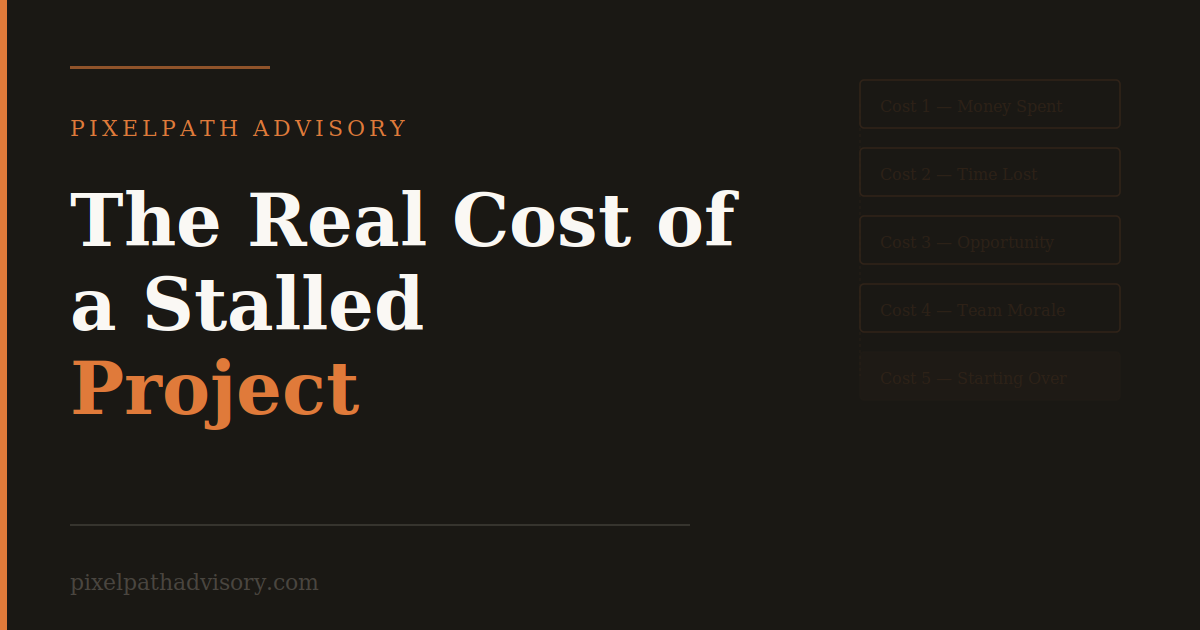
Besides the invoice, this is what a stalled project costs abusiness.
Cost 1 – The money already spent
Whatever was paid to the developer is the floor cost, notthe ceiling. Everything else adds to the bill.
Cost 2 – The time that can’t be recovered
This can have a significant impact on a founder. In the timethat a project has stalled the world has moved around the founder. Six monthsof a delayed project isn’t just six months of fees, it’s six months where competitorshave moved, six months the team went without a tool, six months of the founder’sattention consumed by a failing engagement instead of running the business, orsix months of new priorities building up. This is all time that the foundercannot get back.
Cost 3 – The opportunity cost
What didn’t happen because the founder was waiting for thesolution? Founders who spent months managing a failing software project werenot spending that time pulling in new clients, establishing new products, or findingnew markets. The revenue not generated during that period is a real cost thatnever appears on an invoice but is often larger than what was paid to thedeveloper.
Cost 4 – Team morale and trust
If the team is waiting for a new tool that would make theirlives easier and the founder fails to deliver, that will reduce the trust fromthe team. It will also make the team reticent to buy in to future initiativeswhen they watch resources disappear into a project that never delivers. Slowadoption by the team will be a recurring cost that creeps up whenever a newinitiative is started.
Cost 5 – The cost of starting over
If the hard decision is made to restart the project, thenthe amount paid in invoices essentially doubles. A new developer needs to comein, review the work done, decide on what can be salvaged, and restartdevelopment. In the best-case scenario, some of the work done will be reused. Inthe worst case everything gets thrown out and the founder starts from scratchcausing them to pay double for the same product.
Software projects are always a little complicated and theycan stall. If this happens the most important first step for the founder isdiagnosing what went wrong. Don’t hire a new developer until you understandwhat failed with the first one. Don’t throw more money at the problem until youknow what problem you are solving. Slow down, document what you have, and getan honest read on the situation before you commit to a path forward.
Getting an independent assessment of what went wrong beforecommitting to a recovery plan is almost always worth the time and cost. Astalled project may feel like a sunk cost, but it’s really a decision point.The decisions you make coming out of a stalled project determine how much itwill ultimately cost.
If you would like a second set of eyes on your softwareproject’s status, book a free 45-minute call. No pitch, just a real conversation.